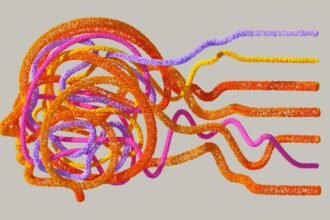


We assume vision, hearing, and what the mind records are direct. However, what if we tell you that this assumption is wrong in a simple but important way? The idea of predictive processing suggests that perception is not passive. It is built. The brain forms an internal model. It updates that model using sensory input. What we experience is not raw reality. It is a controlled output.
So the question appears.
Do we see the world itself or a constructed version of it?
What Predictive Processing Means
The brain does not wait for data to understand the world. It predicts first. Then it checks what arrives through the senses. If the match is close, perception continues smoothly. Afterwards, if it is not, the system adjusts. This cycle repeats without pause. Perception is therefore not reception. It is comparison. The brain is always guessing, then correcting.
That is the core of predictive processing.
The Brain as a Prediction System
The system has three steps.
- First, it builds an expectation of what should be present.
- Second, it compares that expectation with incoming signals.
- Third, it reduces the gap between the two.
This happens quickly. It happens constantly. There is no moment where perception is purely “raw.” What reaches awareness is already processed. The result feels direct. It is not, as it is the endpoint of inference.
Why Prediction is Necessary
The environment is too dense with information. If the brain processed everything from zero, it would be too slow to function. Prediction solves this. It reuses past structure instead of rebuilding from scratch. This reduces load. It increases speed, and also improves survival response in uncertain conditions. Predictive processing is not optional. It is efficient design.
Experience Builds the Model
Every past moment leaves traces. The brain stores patterns. These patterns become reference points. So when new input arrives, the system asks a simple question.
What does this resemble?
This is why recognition feels immediate. Incomplete data is still enough. The system fills gaps using prior structure. In predictive processing, memory is not passive storage. It is active influence, and effectively shapes the current perception.
Why the World Feels Stable
Life appears consistent. Objects remain. Patterns repeat. Behavior becomes familiar. Because of this, predictions usually match input. When match is strong, perception feels stable. The system does not need correction often. So awareness runs smoothly. There is no awareness of the process underneath. Only the outcome is experienced.
That outcome is what is called reality.
Prediction Error
Mismatch still occurs. This is prediction error. It appears when expectation fails. A sound is misheard, shape is misread, and a moment surprises the system. This is not malfunction. It is correction. Error signals force updates. Without them, the system would not improve. Learning depends on mismatch.
Predictive processing requires error to function.
Attention and Filtering
The brain cannot process everything.
It selects. Attention decides what enters focus and what fades out. Strong signals are prioritized. Weak signals are ignored. This creates a hierarchy of perception. Some information becomes clear. Some disappear. Prediction and attention work together. One builds expectation. The other controls access.
What is experienced is only a fraction of the input.
Read our other blogs: Social Media is Affecting Your Mental Health: Know How!
Illusions
Illusions show system limits. The brain expects a pattern. Input contradicts it. Instead of immediate correction, the stronger prediction can dominate. So perception shifts away from physical truth. This is not randomness. It is prediction dominance. The model overrides the signal.
Predictive processing explains why this happens without requiring anything unusual.
Hallucinations
Sometimes input is absent. Yet perception still occurs. This is a hallucination. The system generates experience internally. Prediction continues without correction from outside signals. The model runs on its own. This shows a key point.
Perception does not require direct input at every moment. It can be self-generated under certain conditions. Predictive processing accounts for this through an imbalance between prediction and feedback.
Is Reality Lost
Reality is not denied here. External structure still exists. The claim is different. Access is indirect. The brain never touches raw state. It builds a working version instead. Think of it as a map. The map is not the land. But it is useful for movement. Perception behaves the same way.
It is functional, not absolute.
Learning Loop
The system improves through repetition.
- Mismatch appears.
- Adjustment follows.
- The internal model shifts.
- This cycle repeats throughout life.
Nothing remains fixed. Predictive processing is continuous refinement. Each moment slightly updates the structure. Stability is temporary, not permanent.
Emotion and Perception
Emotion changes the weighting. Fear increases threat prediction. Hope increases positive expectation. Neutral input can be reinterpreted through emotional bias. So the same event may produce different experience states. This shows perception is not purely sensory. It is shaped by internal conditions.
Predictive processing includes affect as part of computation.
Mental State Influence
In anxiety, threat prediction becomes dominant. In a low mood, negative expectations become persistent. Plus, in both cases, prediction outweighs input. The system becomes biased toward a narrow set of outcomes.
This affects the interpretation of daily events.
It is not a distortion from outside. It is internal weighting imbalance. Predictive processing frames this as overactive expectation loops.
Efficiency Over Accuracy
The brain does not aim for perfect truth. It aims for usable output. A slightly simplified model is enough if it supports action. So the system prefers speed over detail when needed. This leads to occasional bias. But it also enables fast response in real time environments. This happens because predictive processing focuses on function rather than precision
Direct Experience Question
There is no fully unfiltered moment. Every perception passes through prediction. The perceptual system constructs even simple visual experiences and interprets basic sounds.There is always a layer between input and awareness. That layer is the model. Reality is not directly seen. It is inferred.
Predictive processing places inference at the center of experience.
Conclusion
Perception is not passive. It is constructed step by step. The brain predicts. It checks, and adjusts. What is experienced is the final result of that cycle. This is predictive processing. We do not access reality directly. We access a working model shaped by expectation and correction. That model is usually accurate enough for survival. However, it is not surprising that it also remains a model. Experience is not raw world. It is structured interpretation.